
Imagine you’re watching a true crime documentary; footage of some ancient misdemeanor. You see the families interviewed, a criminologist, or a psychologist, the chief of Police in Paris during the decade the person was at large.
A plot threads through the show. It has to; this is Netflix after all. And at a certain point you feel a heaviness reach up through your chest because the woman they’re interviewing reminds you of someone, and the victim’s family’s grief is all too real.
The ending of the documentary has urgency and pay-off. When you switch off the television you feel as though you’ve been led somewhere mysterious and true. For four episodes they’ve kept you utterly involved.
But is it art if it’s real?
And does it matter either way?
‘Art is the lie that enables us to realise the truth,’ wrote Picasso almost 100 years ago. But what if the thing you’re watching or creating isn’t a lie but actually happened – the Netflix documentary, a childhood photograph, Life Writing?
Last month I plucked up the courage to read aloud a piece of memoir – a flash fiction exercise I’d written – to a friend who was mentioned in it. My piece told the snippet of a story from my adolescence, a portion of my life when everything threatened to tumble into overwhelm. Until it actually did.
The piece was personal to me but the other characters in it were also real people – old friends of mine, one of them no longer living.
Is it art when we tell the truth of what sits inside our hearts?
Or is it something else?
When we take an event that actually happened and sprinkle in some of fiction’s swing, can we call it art? Is a kitchen table art, or only craft? When so many similar tables have existed before, so little of its individual form coming from that particular crafter’s mind.
Over Easter I painted my flat and made the tiresome job a little easier by playing audiobooks from my phone as I rolled. ‘Free Love’ by Tessa Hadley. ‘Sins of my Father’ by Lily Dunn. The first, a work of fiction: the story of an ‘ordinary’ 1960s family suddenly broken by an act of betrayal. The latter, a ‘memoir’ by a daughter exploring her relationship with a glamorous father who abandoned his role to join a cult.
Hadley’s novel feels entirely plausible, almost real. The characters are fully fleshed, their personal dilemmas true. And Dunn’s memoir is so emotionally on point, so utterly vulnerable and close to the young self she portrays that I felt, as I listened, that I’d been absorbed into a film, to the extent that I somehow ‘became’ the child who’d been betrayed, as I listened.
The skill in Dunn’s work is that her memoir employs the tools of fiction to keep the reader gripped. We are captured by the ‘characters’ – real as they are (I was particularly taken with the mother who seemed to me such a strong and sympathetic person). And I could follow the arc of each of them, rooting for the protagonist, hoping for a particular ending, even as I remained conscious that the story had already taken place, in the ‘real world’ and the writer would remain loyal to the events of her life.
Perhaps it’s ‘art’ as soon as we tinker with what’s ‘real’ – even in the smallest of ways.
Art, when there’s even the subtlest of spin.
This month, I’ve spent weekends touring the Open Studios of my city, this wondrous time of year when artists unbolt the doors of their homes and let the public in to view their work.
Yesterday I spoke to a painter who said that people seem to respond particularly well to chatting with the person who made the piece, as they buy. It seems to give them a feeling of closeness to the work, he said. Perhaps we all want to witness the cogs and wheels of process even as we admire the end result. Over these past weeks I was certainly drawn to artists with whom there was already an established ‘real world’ connection: the cousin of a friend, a man who paints the city where my grandparents used to live.
‘Culture is Ordinary’, wrote the art critic Raymond Williams in 1958. And wasn’t it Andy Warhol who famously said: ‘Art is anything you can get away with’ ?
But isn’t it perhaps the other way round? The filter on the camera – the voice – doing the telling that makes it art? Isn’t the ‘truth’, in fact, simply the angle of the artist – the particular patch of earth on which they stand?
If we’re already friends, or you sometimes read this blog, you’ll know I’m working on novel 2. The work is fiction but every word is true: a patchwork of people and places, a plot that never happened except in my mind. Sometimes I wonder if I should drop the veil and simply write from my life, use the clay* I already have, stop fearing the exposure of real events.
But then I recall the writer John Irving:
‘Half my life is an act of revision.’
And I know that writing is possibly a bit like dreaming – a way of refashioning thoughts and events into a space where a type of reckoning – or even resolution – might occur. Where else but the page – and the imagination – do we get to remake our experiences, ideas – perhaps even ourselves? And what freedom comes, however we put it down, from harnessing those thoughts into language: of lending them our ‘art’.
Sins of My Father – A Daughter, A Cult, A Wild Unravelling by Lily Dunn is published by W&N
Free Love by Tessa Hadley is published by Penguin,
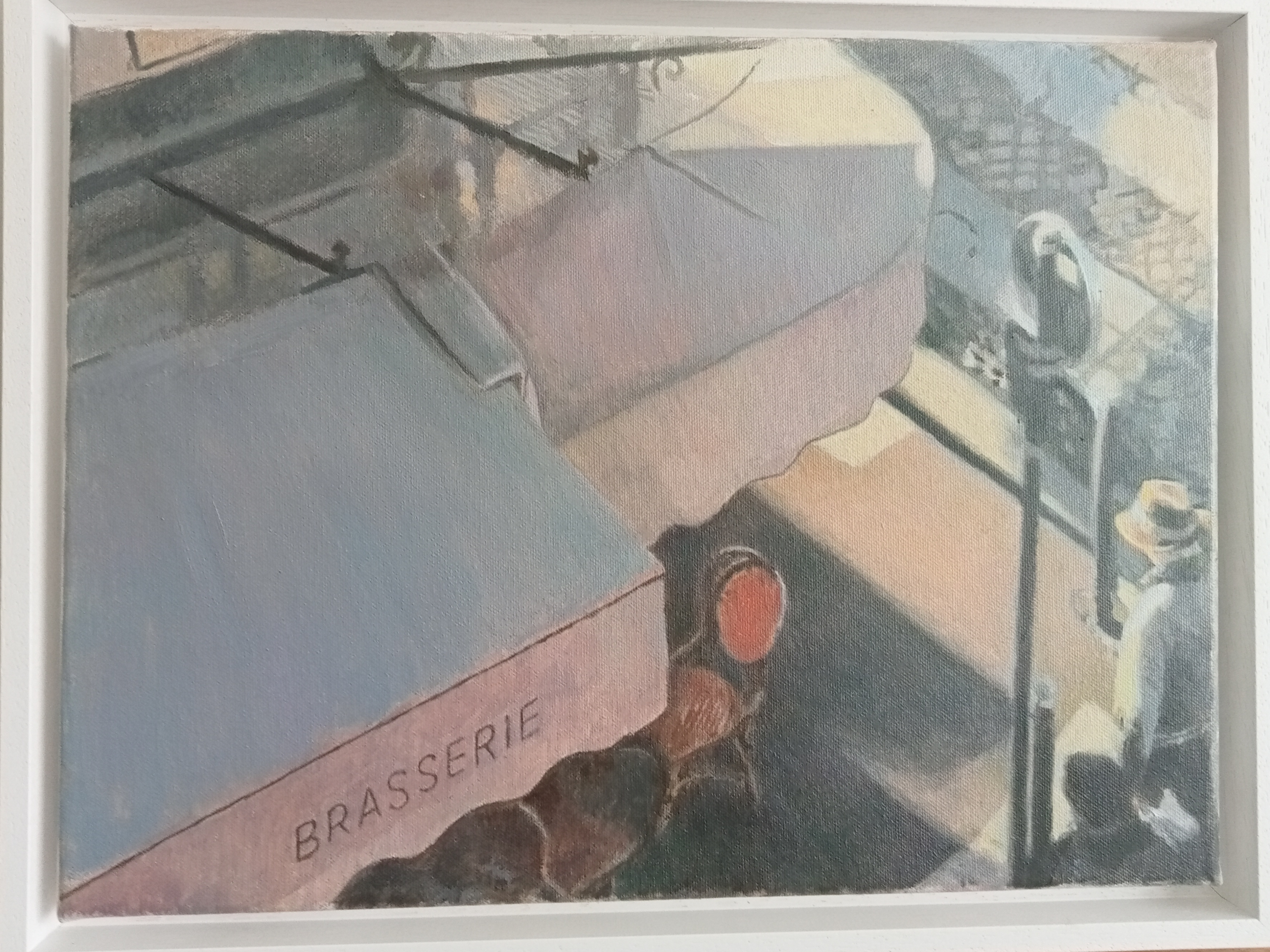
The banner photo is a 2023 painting by Andy Dakin called ‘Brasserie, Red Chair, Chapeau de Cow-Boy’ (www.andydakinartist.com)
Cambridge Open Studios is on across the city and nearby towns until Sunday July 23rd 2023 (https://camopenstudios.org/).
I review books I’ve loved. All views expressed in my posts are my own. This blog is not affiliated to any other individual, company or advertisement. If you’d like to get in touch, please visit my contact page, here.
Your comments as always are welcome…
*from an idea I first heard from author and editor, Natalie Young (‘making clay’ – ie. getting the words or truth of a story down first, in order to have something to work with).
 Muscat Tales
One thought on “Is it art if it’s true?”