After almost a decade of writing this blog, and having now left Muscat, I am shifting these Tales to a new space. You’ll still find the old content on here but from now, you can find my writing at:
If you haven’t yet subscribed to my blog, feel free to subscribe over there; I’d love to keep sharing my posts where I review books, and reflect on current cultural contexts and their impact on stories. There might even be a bit of life writing there too.
Here’s the link to sign up if you’d like to receive fresh-pressed pieces into your inbox: (note – it’s free (unless you’d like to pledge :)) – just choose No pledge and then Continue without pledging (see image below) to receive my posts whenever I write them.
Thank you for reading, my OG subscribers to Muscat Tales – or if you were just floating by and found your way here, you are most welcome on my new substack!
‘And everybody knows that the Plague is coming Everybody knows that it’s moving fast Everybody knows that the naked man and woman Are just a shining artifact of the past…’
Leonard Cohen
I started writing this piece in early April 2020 when the world was shutting down, when we didn’t know what was to come…
I was living in Muscat, Oman. Already a fish out of water when the city of A roads and no discernible centre went silent. Only the waves crashing against Azaiba Beach seemed to soothe the sense of emptiness around.
I want to honour that time because perhaps it is only now, three years back into my life in the UK that I can look back…and breathe.
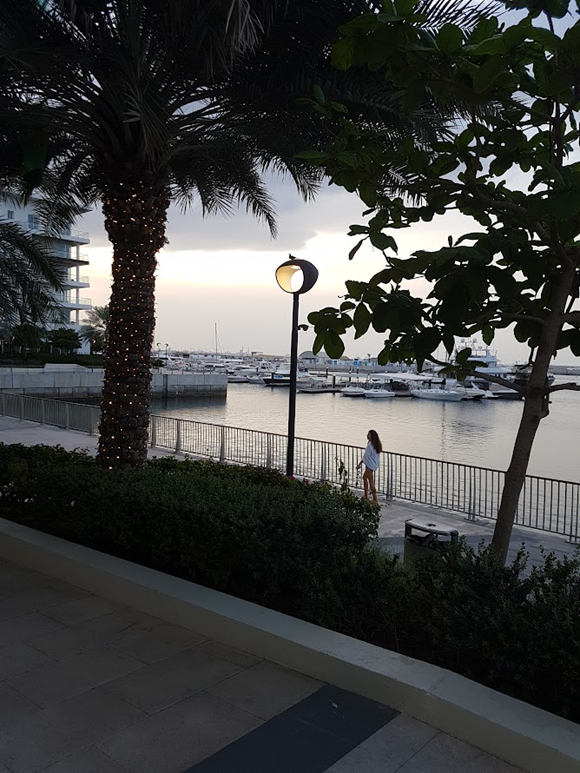
The speakers at the centre of The Wave’s commercial zone in Muscat are still playing music – or muzak – to accompany shoppers and strollers, cafe loungers, as they enjoy the last of the evening sun. But there are no ears here to listen, or almost none. And the screens which line the boardwalk next to the Marina, showing chefs at work, families eating in restaurants – restful candy for the leisured eye – are testament to another time, when walking freely is not privilege, but norm.
I’m reminded of camping as a child, and that time before dusk, when people parade the dusty campsite avenues having showered after a day at the beach, relaxing in the evening light, as they smile or nod hello. Because everybody’s part of something bigger. We share the same air.
And everybody knows.
But what exactly did we know in the streets of The Wave, Muscat at 5.45pm on a weekday evening in April 2020? What could we discern of the months of restriction yet to come?
That afternoon, I set out on my daily walk – by car. In this sense, Muscat is like L.A; you have to drive the endless freeways to find signs of life, and even then, the city exists in isolated pockets: Azaiba, MQ. The Wave – societal limbs on a body without an obvious heart.
When I first moved there, I searched diligently for a community hub, the cultural centres, museums and coffee shops – which did exist, but in a disparate way. After 8 years in Oman, I eventually resigned myself to the truism of Gulf Arab life; the extended family IS the community (And its setting? Cool palatial homes with sitting rooms so spacious you might lose yourself or others among the beige and fawn, the Persian rugs, the semi-see through blinds). In Oman, external social infrastructure is still but a sketch on the city’s rugged landscape.
Earlier that evening, in 2020, my usual choice to stroll – Muscat Hills Golf Course – isn’t letting people in. A couple of kilometres down the road, the beach at Azaiba is manned with police officers who politely tell me that the sand and the sea are off limits.
I turn the car around and wonder: In normal times, where exactly was the busiest part of this city? The place where everybody congregates. And I picture the cafes and shops burbling with life at The Wave, a nearby housing and commercial district. And I reason: Even if all its locales are closed, because The Wave is also a public zone full of villas and apartment blocks, then nobody can shut it down.
So I drive straight there and find there’s almost no one thronging its sidewalks apart from a few children let out of the cage of an apartment, calling up into the fast-fading light. Behind them, employed adults are cajoling; they too are taking in the air.
Before covid hit, trying to practice my limited Arabic with the supermarket cashier, I was reminded of the Jamaican slogan, No Problem! which became universal in the 1980s.
Oman is truly the Jamaica of the Gulf. Its population, as small as an island’s, is intricately linked via relaxed social custom. Strangers ask of your health, your family’s health, their calm politeness is a balm, any inconvenience in this country relieved by the chilledness of its folk.
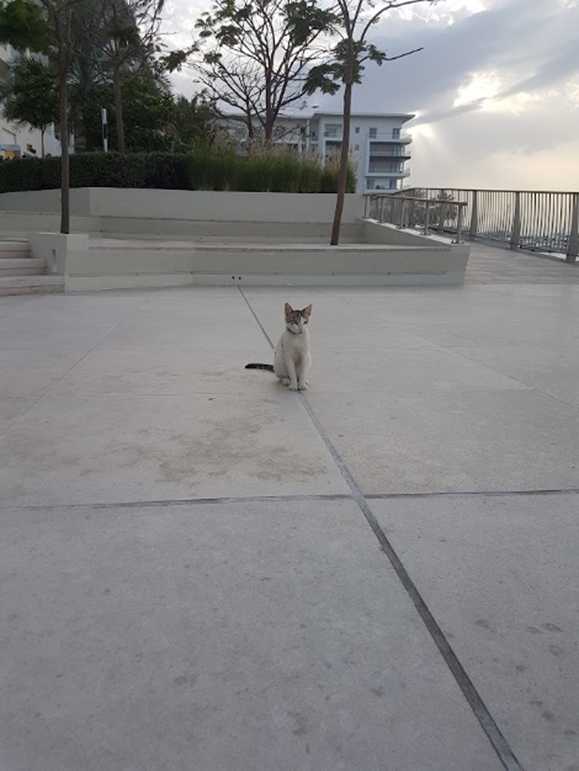
But the only community to be found on the streets of The Wave that evening in April 2020 are cats. They dot the paving like dancers on a near empty stage. Tame ones with ribboned neckpieces. Feral ones the colour of sand. With the sea to my left, I skirt the boardwalk, weaving around their nonchalant poses. I make a poem in my mind, unaware that this temporary silence may take the best part of two years to break.
And then, within a month, everybody knows.
We mask up. Dettol spray becomes our welcome home. In Oman, my life pre-covid had been quiet. Soon I became like a lone vessel floating on the Arabian sea.
A few weeks in, my then husband was called to Germany for an urgent family matter. He spent weeks there with no end in sight.
And I was left, for the first time in my life, socially distancing in a flat in a foreign land. Entirely alone. For several months I had been writing – the peace in Oman had been an ideal backdrop for the work – but now, the silence seemed to warn.
One day, visiting an acupuncturist, the rickety lift to the top floor abruptly jammed. As I waited, static, between levels, I pressed the alarm button, and thought: What if nobody comes?
Who will even know I was there?
Later that week, doing yoga in our living room, I was jolted out of a pose by a face staring through a window at me from across the apartment blocks. Suddenly seen – unknowingly – fear rose in my throat. Not from the sudden visibility, but the sense of being an object to observe that alarmed. I was peripheral to the world – an extra; no longer contributing to this great human scheme.
As the months trudged on, the uniqueness of that particular spring and then the summer appeared to become a time when pretty much the whole world was holding the same thought – a sudden unity of mind.
Everybody knows.
News reports: Daily acts of bravery: the willingness to help. For once, we weren’t each other’s enemies. We might have been each other’s only hope. And, of course, the cost to our world: Chronic uncertainty. Daily loss. Distancing, shielding…
And then, within a few months – it seemed – fast on their heels came the vaccine. Astonishing, the speed of it – our rope to normal life again.
During those pandemic days, in Muscat, I felt my mind empty the same way as the streets. As though every synapse, formerly nurtured by daily interaction, could no longer quite reach the next. I stopped wanting to eat. I couldn’t read. When a single line of poetry touched me, I wept without end, relieved to be one of the living.
There is often talk of an epidemic of loneliness, but before 2020 I’d always enjoyed my alone time. This was different though. That fall, I joined an online short story writing workshop where the tutor suggested that as a way of writing into character, we might each look inside our personal handbag and delineate its contents on the page.
But like my mind at the time, I guess – or my life in 2020 – the mini leather holdall sitting in the hall of our Muscat apartment contained practically nothing at all. Why should it? There was nowhere I needed to be.
I remember thinking, that afternoon: What does it even mean to have a full life? And when I eventually logged off, I stared for an hour at the screen.
In 2022, flight restrictions lifted, I finally returned to my hometown in the UK, and on another media platform, I posted this:
The joy of returning to Cambridge wasn’t just about old friends and family ties, the greenness of the parks and the familiar sounds from the broad East Anglian skies. When the world woke back up again, I sensed a softening. We had all felt the tug of mortality, the veil between the living and the dead shift far nearer to our personal experience of daily life than many had known before.
How are you? people began to ask in shops, and then they really listened for the reply.
It took time for us to learn to stand at a normal distance from each other again, to not flinch at another person’s sneeze, but slowly we did.
The notion that behind closed doors others’ lives weren’t as perfect as social media might claim became an accepted reality. We had all, after all, watched the BBC newscaster’s home interview three years before, suddenly interrupted by his kids wandering confidently in front of the camera, into the room. And in that moment, we had met his humanity.
Perhaps over the long months of drying masks, of sanitised hands, and enforced distance, a time when we were forced to live online and see right into other people’s homes, we had begun to accept each other better for it.
Did the pandemic return us to ourselves? To the ‘soft animal’ of Mary Oliver’s poem Wild Geese? Looking around the world at recent events, this notion might be a bridge too far, but when I returned to the local cafes, the museums and bookshops of my town, in 2022, back to my job in a local school, I did perceive a shift.
Workplaces have become – by necessity – more flexible. There is hybrid working. The resource of a ‘mental health day’ if you’re feeling out of sorts. Are people kinder? Is the extension of grace becoming part of the vernacular?
I began this blogpost with a snippet of Leonard Cohen’s lyric: ‘Everybody knows.’ And the description of a pandemic, devastating and enjoining, like a time of war, or a natural crisis on the earth.
Everybody has known. It cannot be unknown. This is what I have been left with. There is strength in communally surviving adversity. We have walked through it; and it has shaped us.
If you enjoyed this post feel free to get in touch via Twitter here , and you can follow this blog by going here and clicking on ‘Follow Muscat Tales.’
I’d last read Rooney at the start of the pandemic. But then I heard the author read an extract of her new novel, Intermezzo, on the New Yorker Fiction Podcast in the summer, (you can listen here), when two of the protagonists meet at a chess tournament, and I experienced something quite different. A thrilling moment, both tender and absurdist. Intermezzo already felt like a departure …
In this new work, Sally Rooney writes in a style not present in Normal People. It’s more reminiscent of a Samuel Beckett short story – terse and internalized, and like Beckett’s prose, it packs an emotional punch.
We sit inside the mind of Peter Koubek and sometimes too, the brain of his brother, Ivan. Peter, a barrister, calls the younger Ivan, a chess ‘genius.’ The latter finds his advocate older sibling ‘condescending.’ Sally Rooney moves these two pieces deftly across the plot of Intermezzo as they navigate the taking of a king – the loss of their father.
The desires of the three women in the book we meet mainly through their acts and words. Most skillfully drawn among the quintet of characters is Margaret, a person so sympathetic that her interaction with one of the two men towards the end of the novel felt like the kindest conversation I’d read or seen in years. 22 year old, Naomi, another player on the board, seemed less substantial, but perhaps this is part of her style.
Where Sally Rooney’s writing really flies is in her ability to capture the interplay of live action and a character’s stream of perception. We see fragments of the outer world: a door swinging open, the banter in a pub, and like shards of light on a cubist painting, these outer images are illuminated by the inner worlds of our five. And how rich with feeling these inner worlds. Such delicate humanity in Rooney’s prose.
There is complexity, too, in Peter’s relationship with his ex/not ex Sylvia which feels intriguing and real. Indeed, all of the relationships in the novel which start awkwardly – intentionally so, it seems – develop a rhythm that is captivating to follow, playing out in satisfying sequences, and punctuated by deep philosophical turns that never feel forced.
My favourite of these was a riff on the thinker, Susan Sontag’s aphorism:
‘In place of a hermeneutics we need an erotics of art’*
that Rooney made into:
‘We need an erotics of environmentalism’
(which frankly, as original thought goes, (in this writer’s opinion), sails quite close to the ‘genius’ she ascribes to her chess-playing protagonist!)
I could write at length about the lightness of Rooney’s painterly descriptions of Dublin that hint at enough of an outline for the city to be seen, or the way the author shifts her characters within and around their relationships making us both root for them and want to give them a sound talking to (!) when, (for example – again in the style of Samuel Beckett) – they fail to hear one another or themselves. But it might be better if you read Intermezzo for yourself.
During the pandemic, (like some others, I heard), I found books challenging to stick with. The period itself was bizarre enough, when the very atmosphere of the world seemed to infiltrate my consciousness pulling me away from the immersion of reading. The flicker of the phone screen, social media’s bitesized claims; trying to figure out what to do in a country whose wilderness was its usp (but whose police would no longer let us wander there), all acted on my ability to simply sit down and read.
One great thing the covid crisis brought to the fore, though, and which Rooney does so well in this novel too, is explode the myth that other people have it all figured out. In both scenarios we are given the chance to see the human mess behind closed doors and to soften towards each other all the better for it.
Intermezzo is the first novel I have read since covid that has captured me completely. Enough to put away my phone. To take time to savour its language. Enough to truly care.
The very last lines of the book are what brought the title of this blogpost to mind. Through the character of Peter, Rooney’s lines evoke the mid century author and dramatist, Samuel Beckett’s trademark resolve, through his tramps in Godot, and in The Unnamable when he writes:
‘You must go on, I can’t go on, I’ll go on’
The phrasing of the final line in Rooney’s novel mirrors these words – it is so Beckett, I was at first surprised that his name didn’t feature in Rooney’s afterword (which details other writers’ words or ideas she has drawn on for this novel). But so suffused is Beckett’s sensibility throughout Intermezzo that perhaps his mention would be superfluous; the thanking is in the honouring.
Grief has met me personally this year. Intermezzo, itself a work that handles loss, has been a warm hug, a friend who draws on the ‘genius’ of masters for their solace, an engaging confidante, fresh air.
In brief, I think it’s a masterpiece.
*From Susan Sontag’s essay, ‘Against Interpretation’ (1964)
I review crime novels, contemporary fiction and nonfiction. If you enjoyed this post feel free to get in touch via social media here , and you can follow this blog by going here and clicking on ‘Follow Muscat Tales.’ Or leave a comment below… 🙂
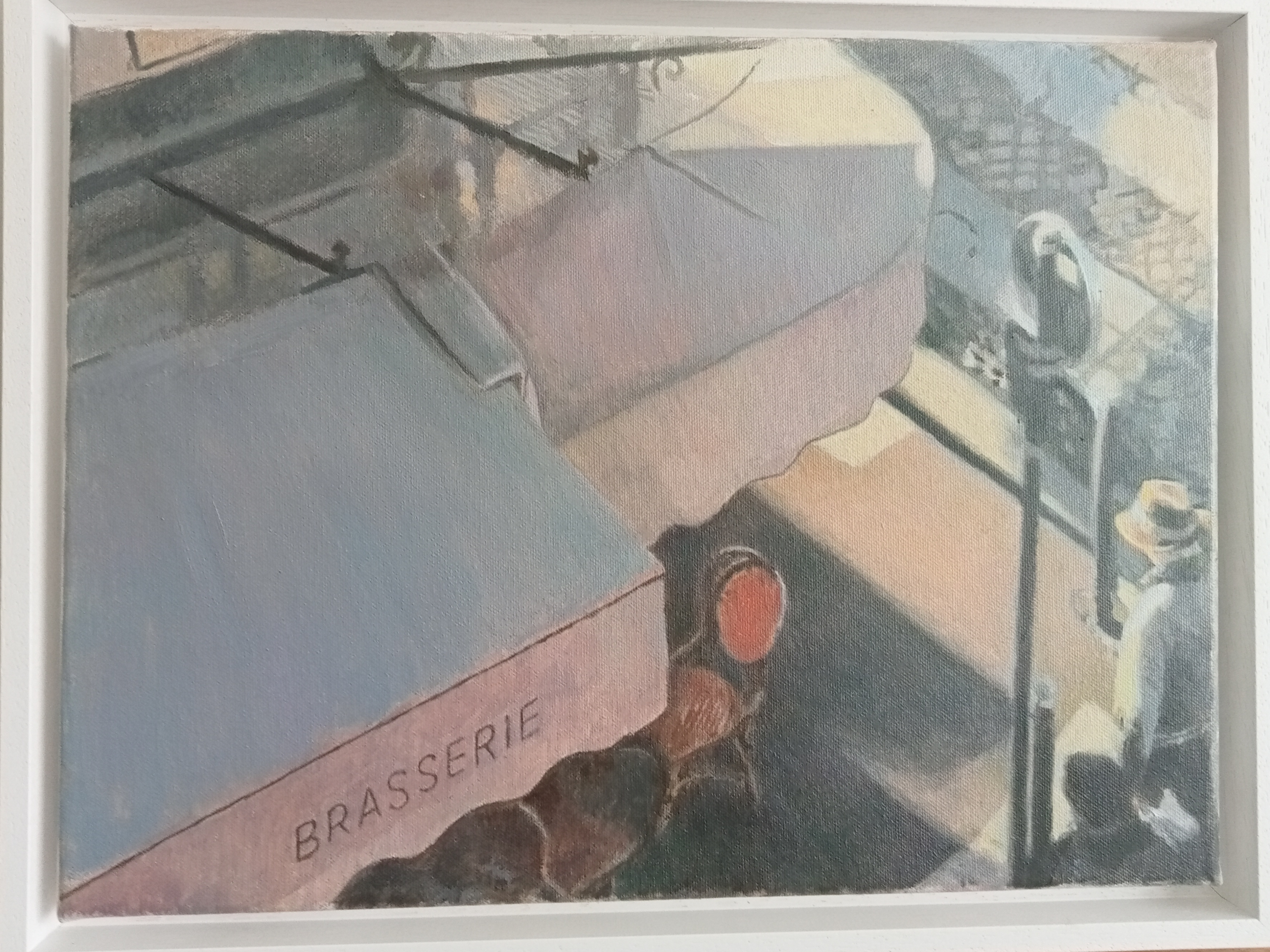
Painting by Andy Dakin, 2023, Brasserie, Red Chair, Chapeau de Cow-Boy’ (www.andydakinartist.com)
Imagine you’re watching a true crime documentary; footage of some ancient misdemeanor. You see the families interviewed, a criminologist, or a psychologist, the chief of Police in Paris during the decade the person was at large.
A plot threads through the show. It has to; this is Netflix after all. And at a certain point you feel a heaviness reach up through your chest because the woman they’re interviewing reminds you of someone, and the victim’s family’s grief is all too real.
The ending of the documentary has urgency and pay-off. When you switch off the television you feel as though you’ve been led somewhere mysterious and true. For four episodes they’ve kept you utterly involved.
But is it art if it’s real?
And does it matter either way?
‘Art is the lie that enables us to realise the truth,’ wrote Picasso almost 100 years ago. But what if the thing you’re watching or creating isn’t a lie but actually happened – the Netflix documentary, a childhood photograph, Life Writing?
Last month I plucked up the courage to read aloud a piece of memoir – a flash fiction exercise I’d written – to a friend who was mentioned in it. My piece told the snippet of a story from my adolescence, a portion of my life when everything threatened to tumble into overwhelm. Until it actually did.
The piece was personal to me but the other characters in it were also real people – old friends of mine, one of them no longer living.
Is it art when we tell the truth of what sits inside our hearts?
Or is it something else?
When we take an event that actually happened and sprinkle in some of fiction’s swing, can we call it art? Is a kitchen table art, or only craft? When so many similar tables have existed before, so little of its individual form coming from that particular crafter’s mind.
Over Easter I painted my flat and made the tiresome job a little easier by playing audiobooks from my phone as I rolled. ‘Free Love’ by Tessa Hadley. ‘Sins of my Father’ by Lily Dunn. The first, a work of fiction: the story of an ‘ordinary’ 1960s family suddenly broken by an act of betrayal. The latter, a ‘memoir’ by a daughter exploring her relationship with a glamorous father who abandoned his role to join a cult.
Hadley’s novel feels entirely plausible, almost real. The characters are fully fleshed, their personal dilemmas true. And Dunn’s memoir is so emotionally on point, so utterly vulnerable and close to the young self she portrays that I felt, as I listened, that I’d been absorbed into a film, to the extent that I somehow ‘became’ the child who’d been betrayed, as I listened.
The skill in Dunn’s work is that her memoir employs the tools of fiction to keep the reader gripped. We are captured by the ‘characters’ – real as they are (I was particularly taken with the mother who seemed to me such a strong and sympathetic person). And I could follow the arc of each of them, rooting for the protagonist, hoping for a particular ending, even as I remained conscious that the story had already taken place, in the ‘real world’ and the writer would remain loyal to the events of her life.
Perhaps it’s ‘art’ as soon as we tinker with what’s ‘real’ – even in the smallest of ways.
Art, when there’s even the subtlest of spin.
This month, I’ve spent weekends touring the Open Studios of my city, this wondrous time of year when artists unbolt the doors of their homes and let the public in to view their work.
Yesterday I spoke to a painter who said that people seem to respond particularly well to chatting with the person who made the piece, as they buy. It seems to give them a feeling of closeness to the work, he said. Perhaps we all want to witness the cogs and wheels of process even as we admire the end result. Over these past weeks I was certainly drawn to artists with whom there was already an established ‘real world’ connection: the cousin of a friend, a man who paints the city where my grandparents used to live.
‘Culture is Ordinary’, wrote the art critic Raymond Williams in 1958. And wasn’t it Andy Warhol who famously said: ‘Art is anything you can get away with’ ?
But isn’t it perhaps the other way round? The filter on the camera – the voice – doing the telling that makes it art? Isn’t the ‘truth’, in fact, simply the angle of the artist – the particular patch of earth on which they stand?
If we’re already friends, or you sometimes read this blog, you’ll know I’m working on novel 2. The work is fiction but every word is true: a patchwork of people and places, a plot that never happened except in my mind. Sometimes I wonder if I should drop the veil and simply write from my life, use the clay* I already have, stop fearing the exposure of real events.
But then I recall the writer John Irving:
‘Half my life is an act of revision.’
And I know that writing is possibly a bit like dreaming – a way of refashioning thoughts and events into a space where a type of reckoning – or even resolution – might occur. Where else but the page – and the imagination – do we get to remake our experiences, ideas – perhaps even ourselves? And what freedom comes, however we put it down, from harnessing those thoughts into language: of lending them our ‘art’.
Sins of My Father – A Daughter, A Cult, A Wild Unravelling by Lily Dunn is published by W&N
Free Love by Tessa Hadley is published by Penguin,
The banner photo is a 2023 painting by Andy Dakin called ‘Brasserie, Red Chair, Chapeau de Cow-Boy’ (www.andydakinartist.com)
Cambridge Open Studios is on across the city and nearby towns until Sunday July 23rd 2023 (https://camopenstudios.org/).
I review books I’ve loved. All views expressed in my posts are my own. This blog is not affiliated to any other individual, company or advertisement. If you’d like to get in touch, please visit my contact page, here.
Your comments as always are welcome…
*from an idea I first heard from author and editor, Natalie Young (‘making clay’ – ie. getting the words or truth of a story down first, in order to have something to work with).
We are constantly telling stories. The unconscious wants coherence. And so we fill the spaces with narrative.
Beginning, middle, end.
I have to stop myself, sometimes. I catch the writer in me wanting a midpoint. A moment of dramatic reversal.
A year ago, with the help of a wonderful developmental editor, I finished writing my first novel. I remember her asking me afterwards if I missed my characters. How I felt about all that work and then the moving on.
In all honesty it was a relief. The novel had started to feel like an albatross around my neck, preventing me from exploring other forms.
After I was done, I queried literary agents and came across tons of brilliant resources for querying writers,
The agency said they’d enjoyed my writing but didn’t think they could sell this book to a UK audience. They asked me to send them the next one once it’s written. Two other UK agencies responded similarly. (Gimme a sec, I felt like saying, I’ll just whip one I made earlier out from a drawer!)
So, I stopped waiting for agency replies and started experimenting with poetry and short fiction.
I enjoy the technical challenge of the short story. A person can tinker with them for days or weeks, sometimes getting stuck on a paragraph or sentence where nothing seems to work. But I’ve found that if I show up day after day – if I keep going – the story, eventually rights itself, like a ship heading back on course.
The waves of my subconscious are calmer when I write. As I start on novel 2, the bulk of the work seems to happen when I leave my desk. The body moves and the mind loosens its grip. Some problems are practical: How old are my characters? How do they speak? Chunks of imagery or dialogue present themselves when I’m out walking or in a downward-facing dog.
Short story writing has taught me to be tight about sentences but a novel first draft is an outpouring that I try to let spill as it will. Listening hard to my characters because if I plan too much, I might just quash their flow. (I like this resource from Lauren Sapala about not dampening ideas with too much preparation…)
I’ve set myself the goal of a messy first draft by Christmas. Readers of my blog, family and friends: please keep me accountable. 🙂
*(a memoir about growing up in the UK Gypsy community and the author’s revisiting of the ‘stopping places’ of his childhood. Incredible book! My stand-out read of the pandemic.)
…………………………………………………………………………………………………
Readers, writers, poets, actors, artists, what are you working on? Feel free to comment below…
If you enjoyed this post feel free to get in touch via Twitter here , and you can follow this blog by going here and clicking on ‘Follow Muscat Tales.’
‘What Doesn’t Kill You,’ is an anthology of short stories and a couple of philosophical essays centred on a single theme: adversity.
Its contributors are authors, journalists and figures from the British media, and the topics it covers are broad.
I enjoyed reading ‘What Doesn’t Kill You,’ for a number of reasons but not for the ones I was expecting. If you love – as I do – to leaf through the overcoming of hardship – the long-earned joyful walk to all kinds of personal victories – then this may not be the book for you.
This anthology, travels, instead – to borrow a term from Pilgrim’s Progress – to a series of ‘sloughs of despond,’ personal difficulties which its writers have experienced and then invites us to take a look around. This may sound bleak – and many of the tales here are predictably dark – but there is also something deeply connecting in reading of another person’s ‘Struggle’, ‘Self’ and ‘Striving’ (the titles of each section of this anthology) without necessarily learning of their happy ending.
Indeed, despite the occasional musings on personal transformation and some beautiful philosophical insights (the elliptical title is borrowed from Nietzsche), this anthology could not be classed as ‘uplift lit.’ Healing, or even transcendence of past pain is not the focus of this collection.
This said, the writing (and editing by Elitsa Dermendzhiyska) is fabulous. There are breathtaking lines to take away – language which takes us closer to what it feels like when life’s sharpness moves us to the edge.
The exquisite surrealism of Irenosen Okojie’s ‘Three Wise Women’ is a huge treat:
‘I sat in train carriages watching for a far-flung white calla lily to manifest from a rip in a seat.’
Okojie’s storytelling is utterly compelling – poetic and precise – and her descriptions of ‘winter’ searing in the way which they evoke the alienation of an anxious mind.
Alex Christophi’s piece, which is both of the mind and rooted in the flesh, takes us through the recreation of memory and its accompanying thoughts. His words on coming back to present stillness are arresting:
‘…when they finally stop running, they can actually feel the world spinning.’
The meditations on ‘disappearance’ which appeared throughout this anthology were also a thrill to read:
In Ed Mitchell’s story of alcohol addiction, ‘Not Wasted’ where he describes how he went from an affluent lifestyle as a television presenter to living on the streets of Hove, he writes:
‘I disappeared for a year: a sea front ghost.’
‘A Disappearing Act’ by Kate Leaver is a moving account of overcoming an eating disorder, clear-sighted on what it meant to withdraw from ‘the act of living my life’. She writes:
‘It was my best effort to vanish.’
And I particularly liked Hazel Gale’s exploration of leaving one’s own body in ‘The Last Fight’. Her disappearance (and later re-appearance) in her own physical reality, is the story of reclaiming her personhood:
‘What I’d been calling the Self was forged solely of what I thought was required of me by the Other.’
Memory’s disappearance is acutely studied in Emily Reynold’s ‘My Unremembered Life’:
‘Trauma simultaneously erases memory and rewrites it,’
while Elitsa Dermendzhiyska’s tale of using economic theory to try to make uncertainty vanish from her daily life, lured by the ‘promise of an underlying order’ contains great beauty in its truth and vulnerability.
Peppered throughout this collection are nuggets of inspiration, on our personal agency in not just surviving adversity, but the ways in which we might exist in its wake:
‘If I don’t want to go back to prison,’ writes Cathy Rentzenbrink, on tending to herself sensitively in recovery from PTSD, ‘I have to make sure I keep the conditions of my bail.’ and for each of these writers – and for many of us – this keeping out of the ‘prison’ of self-protective suffering might look quite different.
Ben Saunders explores the futility of ‘striving’ in the last section of the anthology, through his piece ‘A Very Long Walk in a Very Cold Place.’ His is a gripping real-life adventure to the North Pole full of grit and grimness, where the true prize cannot be gained externally.
Nature is also at the forefront of A.J. Ashworth’s ‘Eight.’ Facts and images of the sun weave beguilingly through this powerful account of living with panic attacks.
The stories in ‘What Doesn’t Kill You’ neither sugarcoat nor glamourize the difficulties encountered by its authors. There is courage in these very personal tales, many as raw as the pain they’ve endured.
Rory Bremner’s essay is a beautiful description of living life with ADHD, both sensible in its advice to those experiencing similar, and celebratory of the wealth of expression he feels the condition has brought him. His refusal to see ADHD as a problem, instead as a part of himself to be loved, is key to the way that he chooses to live.
In his essay ‘No Cure For Life,’ Julian Baggini takes a characteristically rationalist approach to suffering, shunning the notion of the ‘happy ending’ sold to us by self-help evangelists. He observes the uneven way in which life’s slings and arrows appear to be handed out, and seems to underscore some of the thoughts of M. Scott Peck in his seminal book, The Road Less Travelled:
‘Life is difficult. This is a great truth, one of the greatest truths.’
However in Peck’s book he goes on to say:
‘It is a great truth because once we truly see this truth, we transcend it.’
While ‘What Doesn’t Kill You’ isn’t generally about transcending the adversity it portrays – it reads more as a panorama of lived experience – the gems contained within make it well-worth a look.
I loved the style of Lily Bailey’s ‘The Lily Show’ and found her stream of consciousness sentences a brilliant vehicle into the hellish reality she employs to keep her safe.
‘Maybe…they’ll smash through the set walls and rescue me..’
This is as real an account of mental illness and its attendant isolation that I have ever read.
But what I loved most about ‘What Doesn’t Kill You’ is that it points to other books as safe crossings and scaffolds when life gets tricky. There are some great book recommendations here – from JD Salinger to Clarissa Pinkola Estés – so many of the writers in this anthology finding solace in the printed page.
It has indeed been my own experience that there is a deep hopefulness in the occupation of reading – in seeing the story of another played out and repurposed purely for our benefit – which can be like a hand-hold through life’s sometime rough terrain.
‘Reading was, as ever, an ally in taking my mind away from itself,’
writes Cathy Rentzenbrink.
And it is this which makes ‘What Doesn’t Kill You’, a valuable book shelf addition; each of these 15 pieces – while simultaneously distracting us – draws us closer to our own humanity, especially in this time of societal introspection.
‘It is always hard to believe that the courageous step is so close to us,’ writes David Whyte at the start of the anthology, and in celebrating the beauty and plurality of each of these writers’ challenging life experiences, ‘What Doesn’t Kill You’ empowers us to find our own possible steps when life feels like a struggle.
What Doesn’t Kill You is published by Unbound, available to purchase here (among other outlets) from 11th June 2020.
I review books I’ve loved. All views expressed in my posts are my own. This blog is not affiliated to any other individual, company or advertisement.
Please note – I am currently reviewing selected books whose launches have been affected by the current Corona virus outbreak. If you are an author or publisher please feel free to get in touch (see below) if this is of interest.
If you’d like to email me, please visit my contact page, here.
Thank you to Net Galley for sending me an Advance Reader Copy. Note to readers: there are details from the novel mentioned in this review but (hopefully) no plot spoilers!
Out of Touch by Haleh Agar is a soulful story about two siblings, Ava and Michael, and the ways in which they try to make sense of their family’s past.
Michael lives in New York. Ava, England. And as their current lives unfold we are given glimpses of the way things were between their parents when Ava and Michael were growing up.
Towards the end of the novel, their father, Lee asks ‘What do good families do?’ and it is this uncertainty, this search for a happier future to eclipse a tricky history which seems to fuel both brother and sister in their daily lives.
Earlier in the story, a request is sent by Lee to see both his adult children urgently. As readers we are intrigued to discover how this part of the tale will develop.
The scenes in New York where Michael lives with his partner and son are vividly told, ‘everything in mason jars’ and with a straightforward realism which is compelling and enjoyable to read.
And the appearance of an artist neighbour who is able to see into Michael’s apartment adds an interesting dimension – a twist on the idea of the male gaze – for as she watches him and his young family go about their daily life, it is the female gaze making Michael conscious of his actions, affecting the choices that he makes.
Out of Touch is well paced and yet there is a captivating stillness to its prose, an acute sensuality reminding me of the film, ‘Yes’, by Sally Potter which also looks at shattered family dynamics and cultural crossings.
The international angle is delightfully told, not just through the dual scenes set in the U.S and UK but via the backgrounds of the characters themselves — Lebanese, Greek Cypriot and Iranian. Culturally-specific details add texture to our understanding of the main characters and a liveliness to their histories.
There is much depth portrayed in this novel but also a pleasing lightness to the writer’s style which makes it a book which is hard to put down (I read it in two sittings and I’m generally not a fast reader!)
When something frightening happens to shake Michael and his partner’s family life in New York, his partner Layla responds by becoming overly cautious, taking a hammer on car journeys in case of an accident, deciding to try to become the ‘God’ of the family by checking everything she can. Layla’s anxiety which seems to stem from a disconnection from the nominal faith of her childhood is insightfully handled through the narrative.
While the difficult legacy of Michael and Ava’s mother, Elena, is portrayed in detail there is also space for complexity in our understanding of her. And it is this grappling with the dynamics of family and the way characters try to overcome their histories through new choices that this book is at its most captivating. We are given a window not only into the pain of the past but also the ways in which repair may occur in the present.
The love story at the centre of the novel plays out beautifully. Sam is earnest and believable, Ava wavering and confused until she has to make a decision either way.
There is something warm and life-affirming and ultimately important about the way human difficulties are addressed in this book. I was left at the end with the sense, as a reader, of being seen. The existential questions the characters face – whether it’s possible to make peace with the past (can old disagreements be mended?) and why a look at what happened long ago might shed light on our present responses – feel universal and timely.
I look forward to reading more from Haleh Agar.
Out of Touch is published by Orion, available to purchase from April 2nd 2020.
I review books I’ve loved. All views expressed in my posts are my own. This blog is not affiliated to any other individual, company or advertisement.
Please note – I am currently reviewing selected books whose launches have been affected by the current Corona virus outbreak. If you are an author or publisher please feel free to get in touch (see below) if this is of interest.
If you’d like to get in touch, please visit my contact page, here.
It’s been more than 2 years since my last blogpost… Reader, where has the time flown?
I’ve been working on a novel and was planning to return to this page in the new year, but I must confess I missed the buzz of blogging…
A character from fiction grabbed my attention. It was Frannie, heroine of Sara Collins’ debut novel, The Confessions of Frannie Langton.
A few weeks ago, as reviews filled the Twittersphere and The Confessions of Frannie Langton was ‘Book of the Month’, I was approached by a Waterstones bookseller saying he doesn’t usually read novels but…
‘Try this,’ he urged, holding the paperback pictured below.
I took his advice and bought it.
The premise? A grand Victorian house in 19th century London, a young woman sent to work there from Jamaica, and the accusation of a crime, the double murder of her bosses, for which she may hang.
As she awaits her trial, Frannie gives an account of what actually happened before she was imprisoned. She hopes to set the record straight, taking us through a life spent resisting the servitude into which she was born.
At the centre of the intrigue is the love between the servant Frannie and her mistress, Marguerite, a French ‘eccentric’.
‘Knowing a person’s story, and how they tell it, and where the lies are in it, is part of love.’
And in each of their interactions, as in the rest of the novel, Frannie is determined to be treated as equal, in a household – and world – set on keeping her in her place. Her courage is the engine which keeps the pages of this mystery turning.
There are court testimonies by other dwellers of the house. Not just the masters but the staff too. We meet them in the kitchen and peek at the food that they prepare:
‘…the room was musty and dim, and still reeked of salt and old mutton fat. The cake made up for it. Golden and sweet, and no matter that I knew only too well how the sugar was made.’
Like the hit TV series Downton Abbey, exchanges between the servants are as centralto the story as those of the family, but no cosy historical is this. Imagine characters, with grins and bones protruding, a little larger than life, and you get the idea. Much of The Confessions of Frannie Langton is decidedly gothic.
We also see snippets of a journal written by Benham, one half of the murdered couple. This adds to our picture of Frannie, a forthright mix of bookishness and protest at her lot, an avid reader who even hides the pages of Candide into the seam of her dress so she may continue the story without being seen.
This devotion to literature gives Frannie the language of her oppressors, the tools with which to face them. It’s a wonderful surprise in this suspenseful novel to find that books are not just Frannie’s lifeline but her secret weapon, giving her the confidence to speak her mind, shocking those who would expect her ignorance, and compliance.
If you spend time writing anything lengthier than an email you’ll know that the mechanics of plot can be a challenge to get right. But Sara Collins has nailed it; the pacing of this novel is superb.
In one sense, it’s a classic ‘whodunnit’, but the language is so rich and the literary allusions detailed that another layer is added to what might have been a more generic mystery.
The descriptive passages too are evocative of a London we only usually meet, as modern readers, in the pages of a real Victorian novel (or perhaps a TV adaptation). Yet this book, published in the Spring of 2019, conveys life in the 1820s in exquisite detail.
There’s a sensuality to the prose which makes the voice of Frannie visceral and true.
‘If it was a crime, then I am guilty of it and I confess it here. But I just wanted to keep that book as close as I could get it to my skin. Not to remind myself happiness was still possible, but to remind myself that anger was.’
The novel entwines entertainment and message to extraordinary effect, standing face to face with England’s legacy of racialism without flinching. It enlightens the reader on the part played by pseudoscience to fuel the pro-slavery agenda of the English ruling class in the 19th century.
In another blogpost I explore the challenges writers may face when attempting to marry a thrilling story with a serious point. In The Confessions of Frannie Langton the plot is so deftly handled that Frannie’s righteous anger is made tangible through every twist of the tale. Line after line so well conceived, I must confess I drank this novel.
It brought not just the pleasure of a great yarn – the joy of another world to go to – but a strong social message in the tradition of Charles Dickens.
Frannie Langton’s struggle against appalling cultural forces is made memorable through her bold, unforgettable voice, and the gothic imagery which abounds, shining a light on the ugliness of racial injustice while leading us through the most entertaining – and educational – of confessions.
…………………………………..
The Confessions of Frannie Langton is published by Penguin, available to purchase at all good book shops.
This blog recommends pairing this book with A True Story Based on Lies by Mexican-American author Jennifer Clement, which addresses class discrimination and female servitude in contemporary Mexico.
I review books I’ve loved. All views expressed in my posts are my own. This blog is not affiliated to any other individual, company or advertisement. If you’d like to get in touch, please visit my contact page, here.
A few years ago I was talking to a friend and a light bulb landed in my lap. Not a real one – that would have been weird – but an idea I couldn’t ignore. It was a premise for the book I’m writing, whole as a nut.
The idea didn’t magically appear. It came after years of unearthing what on the surface seemed to be nothing at all. Until one day I understood a situation I couldn’t ignore, asking to be written.
Here’s a thing: Sitting with an idea is beautiful; crafting it into a tale is something else.
At the time, I was passionate for people to know what I thought about my subject. So much so that having laboured for months on the first draft, I realised my book – all 60,000 words of it – was in fact a lecture.
It got me thinking: Was I writing a novel or a manifesto? How could I give the reader space to think for themselves?
I didn’t have an answer.
But as I worked on draft three, some principles became apparent. So I’ve put together my notes on toning down message and amping up story. In case you’re going through similar (or curious!) here they are:
The reader is everything. When crafting a story, being like a courteous date and keeping their experience in mind shifts the focus to their journey (instead of the writer’s opinion).
When I wrote a manifesto for my beliefs (rather than a properly constructed story), feeding characters lofty speeches, I knew deep down that the part of my reader who was fired up to go on a journey would likely drift off…
Instead, I considered:
Asking questions. What if ones preferably. I just read a wonderful book (reviewed here) where the writer never answered her central question: Could anxiety actually be useful? Positive even? She generously left it up to the reader and her idea has remained with me ever since.
Investing in a brilliant book on plot (like the one in this post – here). Most writers need a map of some sort, to know where we’re leading you. Whatever your system, constructing a story which works will serve as a vehicle for your idea (and then you won’t have to lecture anyone!)
Your characters, after a while, may stop sitting on the page and instead fill your thoughts at the most inopportune moments. Let them. The more real they are, the more they will carry the story’s weight. There is an advantage in writing multiple drafts. You’ll really get to know the people in your story and they’ll start to work harder for you.
Research as much as you can. For me this involved travelling back to Madrid twice (here), note-taking verbally with a mobile phone at every location (feeling like Kermit the Frog in his reporting moments).
Readers like to travel without getting on a plane – if you can get them so immersed with the sights, sounds and smells of the story that they don’t notice your message until after they’ve put the book down, you’ve done it!
Storytelling – they say – is crucial to human survival. The strange thing that happened to me, might trouble you too. Or maybe you’re looking for a window into something you’ve never thought about before. Stories remind us who we are and were and want to be. They contain the type of glue that can stick whole lives back together.
So what are you waiting for? The manifesto in your mind, that premise you’re longing to explore, make a start. You never know whose life you might touch with your art.
I’d love to read your tips – writers – on how – if you’ve got a premise or a point to make – not to lecture your reader in a novel!
Thank you to Quinn Dombrowski for the image, ‘Pontificating’ at the top of this post via creativecommons.org











 Muscat Tales